At the Guild’s August monthly meeting member Benoit Philippe provided members and guests with a demonstration of a coastal scene in oils in the style of the Fauvists. Benoit started by giving a brief overview of this art movement:
Fauvism emerged in France at the beginning of the 20th century (around 1904) and lasted until 1910. The style is characterized by vibrant, non-naturalistic colours; simplified, often abstract shapes, and expressive brushwork. Artists who painted in this style at some point in their careers include Henri Matisse and André Derain who were at the forefront of the movement. Maurice de Vlaminck, Georges Braque, Raoul Dufy and Albert Marquet also produced Fauvist works.
The first exhibition of paintings in this style was the Salon d’Automne, which took place at the Grand-Palais in Paris in 1905 (Room VII). The term “Fauves” (meaning “wild beasts”) comes from an article reviewing the exhibition and published in the Gil Blas newspaper by the art critic Louis Vauxcelles:
“In the middle of the room, the torso of a child and a little marble bust by Albert Marque, who models with delicate science. The candour of these busts surprises among the orgy of pure tones: Donatello among the fauves [i.e. wild beasts]”
Two more exhibitions will feature fauvist paintings: The Salon des Indépendants (Paris – 1906) and the Salon d’Automne (Paris – 1906).
Benoit started his demonstration with the white of the canvas, outlining in blue paint the main areas of his subject which was Brixham Harbour. Using thinned oil paint to block in saturated colours, he changed brushes frequently to retain luminosity, only adding any white to his mixes towards the end of the session. With the main structure of the painting in place, it would be allowed to settle, he would re-evaluate and make any necessary refinements later.
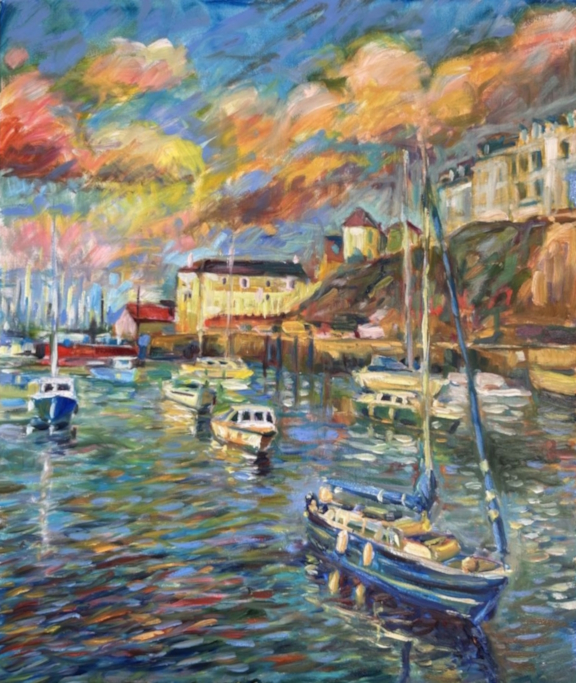
With thanks to Benoit, a very interesting evening with members encouraged to at least try out a painting in this vibrant, simplified style.
Leave a Reply